


In the Translator's Workshop: Featuring Rachel Hadas on Charles Baudelaire
Updated: Jul 22

Introduction to The Translator's Workshop
George Steiner wrote one of the most perceptive books we have on translation and based its title on one of our most profound parables on ambition and communication: After Babel. As a sometime translator myself, I know first hand the Babel-like misunderstandings that bedevil all those who would dismantle and rebuild a tower of words.
I am aware, accordingly, of the poet-translator’s background sense of the endeavor’s futility, one that writers have lamented for hundreds of years. In Don Quixote (quoted here in John Rutherford’s translation), the priest who helps burn Quixote’s books of chivalry remarks, “...He [the translator] left behind much of what was best in it, which is what happens to all those who try to translate poetry: however much care they take and skill they display, they can never recreate it in the full perfection of its original birth.”
As Cervantes notes, a translator’s problems compound specifically with poetry, so deeply dependent on nuances and idiosyncrasies in the language of its composition. Readers rarely learn about the “inside baseball” behind a translator’s choices and sacrifices, about dilemmas of etymology and connotation, about the slippages between counterpart, counterfeit words. In poetry translation, when it’s done correctly, no detail is too pedantic, no feature of syntax or diction is irrelevant, and no choice is trivial.
I reached out to poets who translate from languages or cultures far afield from English: Norse, Russian, Ki’che’ Maya (Castilian), Chinese, Sanskrit. I asked the poet-translators to focus on a line or stanza and share the nitty-gritty of moving poetry between the original and English. This series features the translators' mini-essays, showing us how much thought and hard work go into what poetry translators do.
Amit Majmudar Marginalia's George Steiner Editor for Poetry & Criticism
Translating Baudelaire: Love Led Me to a Thicket of IVs
I’m dipping in memory, into a period of translating with speed and intensity over a few weeks in 1990. My memory is helped by the introduction I wrote a few years later to my collection of translations, Other Worlds Than This, (Rutgers University Press, 1994). I retrieve some language from the introduction but also add something new: now I focus on a couple of lines from my rendering of one Baudelaire sonnet, “La Fontaine de Sang.”
When, early in the summer of 1990, I began to translate some of Baudelaire's poetry, it wasn’t a considered decision. I seem to have simply started. “Sonnet in Autumn” came first, followed by “The Fountain of Blood;” and then, happy with both the process and the results, I pressed on, for the next two or three weeks, at the rate of a poem every couple of days, which now that I’m seventy-seven years old, astonishes me.
Putting these poems into English felt almost impulsive, but in fact it was overdetermined. For one thing, Baudelaire had long been a crucial poet for me. My 1988 essay “The Cradle and the Bookcase” owes its title to the first line of his poem “La Voix,” Mon berceau s’adossait a la bibliothèque,” though at that time I didn’t feel ready to translate the whole poem. As early as 1983, I had written a brief comparison of Baudelaire and the Greek poet Karyotakis (1896-1928), whose work then seemed to me too intimidatingly elegant, idiosyncratic, and complex to be translatable at all. Translations of Karyotakis into English were pretty scarce. I produced some in 1991, and these are also collected in Other Worlds Than This, whereas Baudelaire has of course been blessed and cursed with innumerable versions.
Aside from a conviction, as I settled down to work in June of 1990, that the poems in Les Fleurs du Mal could and should be made to rhyme in English, I had no conscious thought of improving on other translations. I was doing this work for the pleasure and absorption it provided of repeated plunges into a seductive medium, and not just a medium, a world.
I was constantly aware, as I proceeded, of the poetry group I had been leading up through the previous month at the Gay Men’s Health Crisis in New York. Illness and sensuality, desire and despair, the reality of a winter city and the dream of freedom, health, and repose (luxe, calme, et volupte) had their counterparts in the lives and work I had encountered week by week all year. As I made my way via the first few poems into Baudelaire’s peculiar territory, I kept thinking of the writers in this group, all of whom had AIDS.

In the sonnet “La Fontaine de Sang”, ("The Fountain of Blood") the octave evokes a city so inundated with blood that all of nature turns red. The sestet becomes far more personal, providing a capsule history of the speaker’s vain search for any substance or experience that might allay his terror. Wine doesn’t help; on the contrary, “Le vin rend l’oeil plus clair et l’oreille plus fine!” Wine sharpens the senses.
What about love as a balm for existential dread? In the sonnet’s final tercet, blood, though unnamed, reenters the poem:
J’ai cherche dans l’amour un sommeil oublieux;
Mais l’amour n’est pour moi qu’un matelas d’aiguilles
Fait pour donner a boire a ces cruelles filles!
Those thirsty, vampirish “filles” are hardly the solution either.
In the penultimate line, Baudelaire’s mattress stuffed with needles defeated my attempts at a graceful rhyme. What came to me instead was an image of a hospital patient bristling with tubes: transfusions, infusions, IV poles. For the first time in my life, I’d been spending quite a bit of time in hospital rooms around town, visiting some of my poetry students. Blood did not need to be mentioned; it was on everyone’s mind.
Here is my admittedly free rendering of the sonnet’s final three lines:
I looked to Love to cure my old disease.
Love led me to a thicket of IVs
Where bristling needles thirsted for each vein.
It sometimes happens when one is writing, which includes translating, that the decision, the solution to a problem seems to arrive without conscious effort. My rendering of the sonnet veers abruptly, in the last two lines, from reasonably accurate to something altogether freer; the image changes radically. Does my version work, or is it misleading?
The answer is that it depends. I’d advise readers to compare other renderings and make their choice. Or better, don’t choose; rather, somehow embrace the multiplicity of ways translators have wrestled with these lines. Nothing is sufficient, but maybe every attempt, every solution is also, in its modest way, necessary. Even (or especially) at the level of the individual line, the riches of Baudelaire’s poetry are infinite.
Read Hadas' full translation: "The Fountain of Blood"
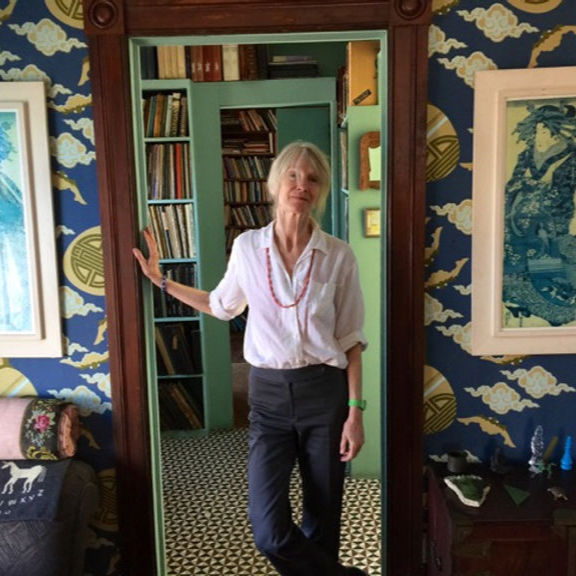
Poet, essayist, and translator Rachel Hadas is the author of many books of poetry, including, most recently, Pastorals (Measure Press, 2025) and Ghost Guest (Ragged Sky Press, 2023). A selection of her essays and criticism can be found in Piece by Piece (Paul Dry Books, 2021). Hadas’s honors include a Guggenheim Fellowship in Poetry, an Ingram Merrill Foundation grant in poetry, and an award in literature from the Academy-Institute of Arts and Letters. She is a recipient of the O.B. Hardison Poetry Prize from the Folger Shakespeare Library and has been a Fellow at the Cullman Center for Scholars and Writers at the New York Public Library. A member of the American Academy of Arts and Sciences, she has been a resident of the MacDowell Colony, Yaddo, and the Virginia Center for the Creative Arts.
Amit Majmudar is Marginalia's George Steiner Editor for Poetry and Criticism, a poet, novelist, essayist, translator, and the former first Poet Laureate of Ohio. He works as a diagnostic and nuclear radiologist and lives in Westerville, Ohio, with his wife and three children. Majmudar’s essays have appeared in The Best American Essays 2018, the New York Times, and the Times of India, among several other publications. His most recent collection of essays, focusing on Indian religious philosophy, history, and mythology, is Black Avatar and Other Essays (Acre Books, 2023). He is most recently the author of The Great Game: Essays on Poetics (Acre Books, 2024) Later Adventures of Hanuman (India Penguin, 2024), The Book of Vows: The Mahabharata Trilogy Volume 1 (Penguin India , 2023), and The Book of Discoveries: The Mahabharata Trilogy Volume 2 (Penguin India, 2024). The Book of Killings: The Mahabharata Trilogy Volume 3 is forthcoming from Penguin India. Learn more at www.amitmajmudar.com. Substack: @amitmajmudar (Measureless)


